Sleep notes
Waking up with back pain? How to choose a mattress that actually fits your body
· O'Suan Sleep
In short
If you wake up sore, stiff or already reaching for your lower back, the useful question is not “which brand is best?” It is whether your mattress is supporting your shoulders, hips and spine — or leaving you to guess from a five-minute lie-down in a shop. Independent research finds that a medium-firm mattress is a better starting point for many people with non-specific low back pain than a very firm one. The next step is to see how your own body is actually supported, then choose or configure a mattress around that.
A mattress is not a diagnosis, a treatment or a cure. If pain is persistent, worsening, spreading, or coming with other symptoms such as numbness, weakness or disturbed sleep that worries you, speak to your GP or a chartered physiotherapist before you spend money on a new bed.
Why do so many people wake up sore in their own bed?
It is a familiar pattern in Irish conversations about mattresses: someone spends serious money on a firm “orthopaedic” model, or on a soft foam mattress that felt lovely in the showroom, and still wakes up sore.
That back-and-forth makes more sense once you look at how a mattress interacts with the body. A review of the research by Caggiari and colleagues, published in the Journal of Orthopaedics and Traumatology in 2021, explains the two common problems clearly. A mattress that is too firm may not let the shoulders sink enough, so the neck and shoulders lose support and can feel sore or stiff. A mattress that is too soft can let the hips and shoulders sink too far, so the spine is no longer in a comfortable line. In both cases you can wake up tight, even if the bed felt fine for the first few minutes in a shop.
The same review notes that sleep disturbances are common in adults, and that low back pain is one of the main causes of poor sleep quality. That does not mean your mattress is always the cause — posture, an old injury or a health condition can all play a part — but the surface you lie on for hours is still worth taking seriously. Practical clues include a visible sag, or waking sore in your own bed but feeling better after a night elsewhere.
Is a firmer mattress better for back pain?
Many people are still told to buy the firmest mattress they can find. The clinical evidence does not support that as a general rule.
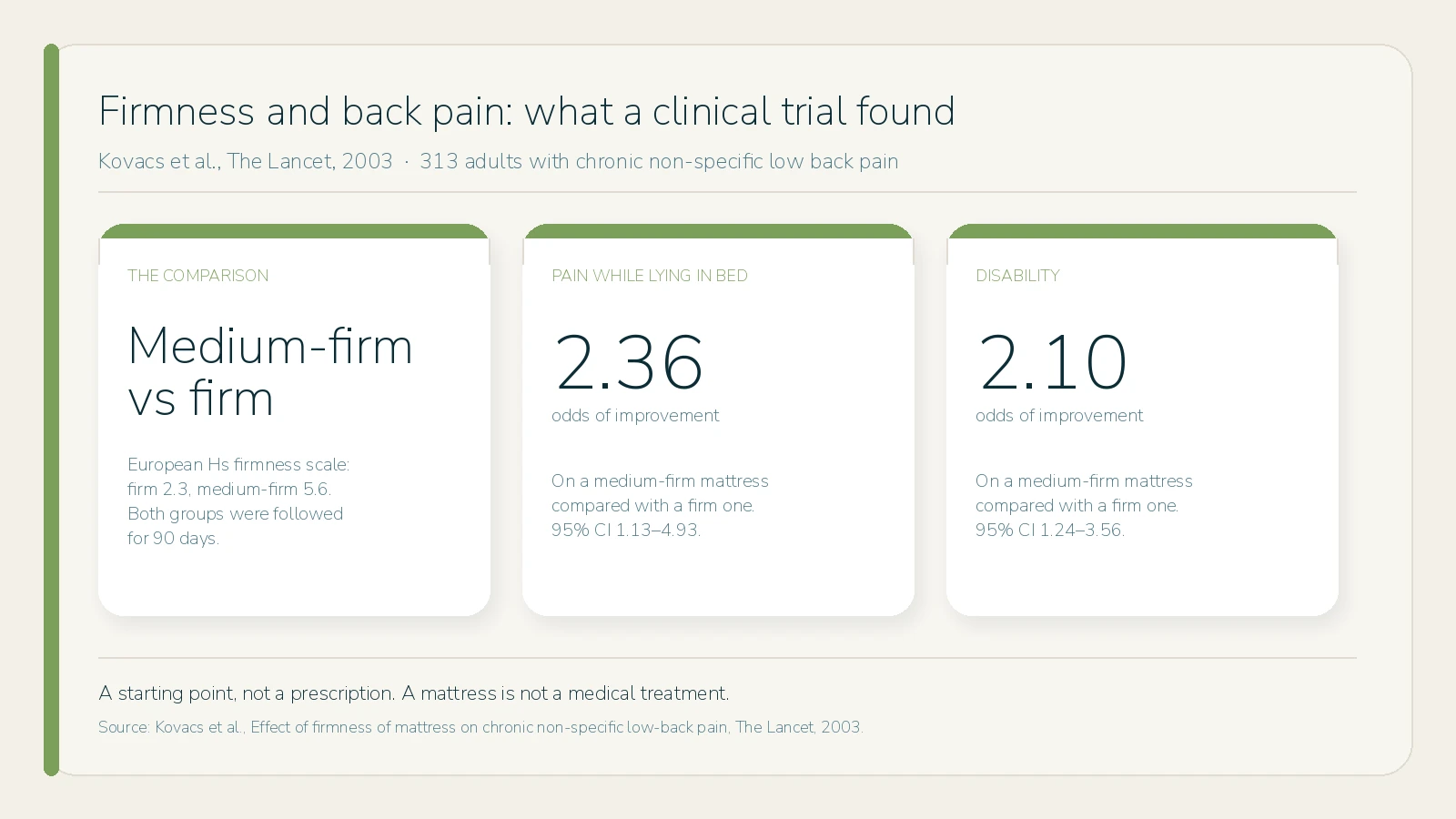
In 2003, Kovacs and colleagues published a randomised, double-blind, multicentre trial in The Lancet of 313 adults with chronic non-specific low back pain and discomfort while lying in bed and on rising. Participants were assigned a firm mattress (Hs 2.3 on the European firmness scale) or a medium-firm mattress (Hs 5.6). After 90 days, the medium-firm group had better outcomes for pain while lying in bed (odds ratio 2.36, 95% CI 1.13–4.93) and for disability (odds ratio 2.10, 95% CI 1.24–3.56). The authors concluded that a medium-firm mattress improves pain and disability among people with chronic non-specific low back pain.
Caggiari et al. later reviewed 39 studies and reached a similar overall conclusion: medium-firm mattresses offer more advantages for people with non-specific low back pain. The review has limits the authors themselves flag — studies used different methods, and the type of low back pain was often poorly described — so “medium-firm” is a useful starting point, not a universal prescription.
Your sleep position and body shape still matter. Side sleepers often need enough give at the shoulder and hip; back sleepers typically need support under the lumbar curve without a hard ridge. If you share a bed, two people can need two different feels, which is why a single shop-floor compromise so often leaves one person uncomfortable.
What should you actually check before you buy?
Look past the label on the ticket — “orthopaedic”, “luxury”, “hotel firm” — and notice what happens when you lie in your usual position long enough to settle.
Lower back and hips
What “good enough” can feel likeYour pelvis feels supported; your lower back is not hanging in a gap or forced into a hard arch
What to be cautious aboutA sag at the hips, or a surface so hard that your lower back is held away from the mattress
Shoulders and neck (especially side sleeping)
What “good enough” can feel likeThe shoulder can settle enough that your neck stays in a comfortable line with your spine
What to be cautious aboutPins-and-needles in the shoulder, or constantly adjusting the pillow to fill a gap
Getting comfortable and turning
What “good enough” can feel likeYou can change position without a big effort, and still feel supported after several minutes
What to be cautious aboutA showroom “wow” that lasts two minutes, or a sink-in feel that makes turning hard
Sharing the bed
What “good enough” can feel likeEach person can get the support they need, even if their firmness preference differs
What to be cautious aboutOne average firmness that suits neither of you well
Decision time and aftercare
What “good enough” can feel likeTime to assess the mattress at home, plus clear warranty and delivery terms
What to be cautious aboutA rushed purchase with no way to check the feel beyond a shop visit
| What to check | What “good enough” can feel like | What to be cautious about |
|---|---|---|
| Lower back and hips | Your pelvis feels supported; your lower back is not hanging in a gap or forced into a hard arch | A sag at the hips, or a surface so hard that your lower back is held away from the mattress |
| Shoulders and neck (especially side sleeping) | The shoulder can settle enough that your neck stays in a comfortable line with your spine | Pins-and-needles in the shoulder, or constantly adjusting the pillow to fill a gap |
| Getting comfortable and turning | You can change position without a big effort, and still feel supported after several minutes | A showroom “wow” that lasts two minutes, or a sink-in feel that makes turning hard |
| Sharing the bed | Each person can get the support they need, even if their firmness preference differs | One average firmness that suits neither of you well |
| Decision time and aftercare | Time to assess the mattress at home, plus clear warranty and delivery terms | A rushed purchase with no way to check the feel beyond a shop visit |
If you can, lie in your usual sleeping position for longer than a quick perch, and bring your partner if you share a mattress. A home trial will tell you more than a shop visit alone.
How does pressure mapping take the guesswork out?
Pressure mapping is a way of seeing how your body and a sleep surface actually meet. In the research literature reviewed by Caggiari et al., this is typically done with a thin, flexible sheet of sensors that records contact pressure — often at the shoulders, hips and lower back — so you can see where load is concentrating rather than relying on a first impression.
That matters because “comfortable for five minutes” and “supportive for seven hours” are not always the same thing. A firmer surface can feel solid in a shop and still create high pressure at the hips or shoulders overnight. A softer surface can feel plush and still let the pelvis drop.
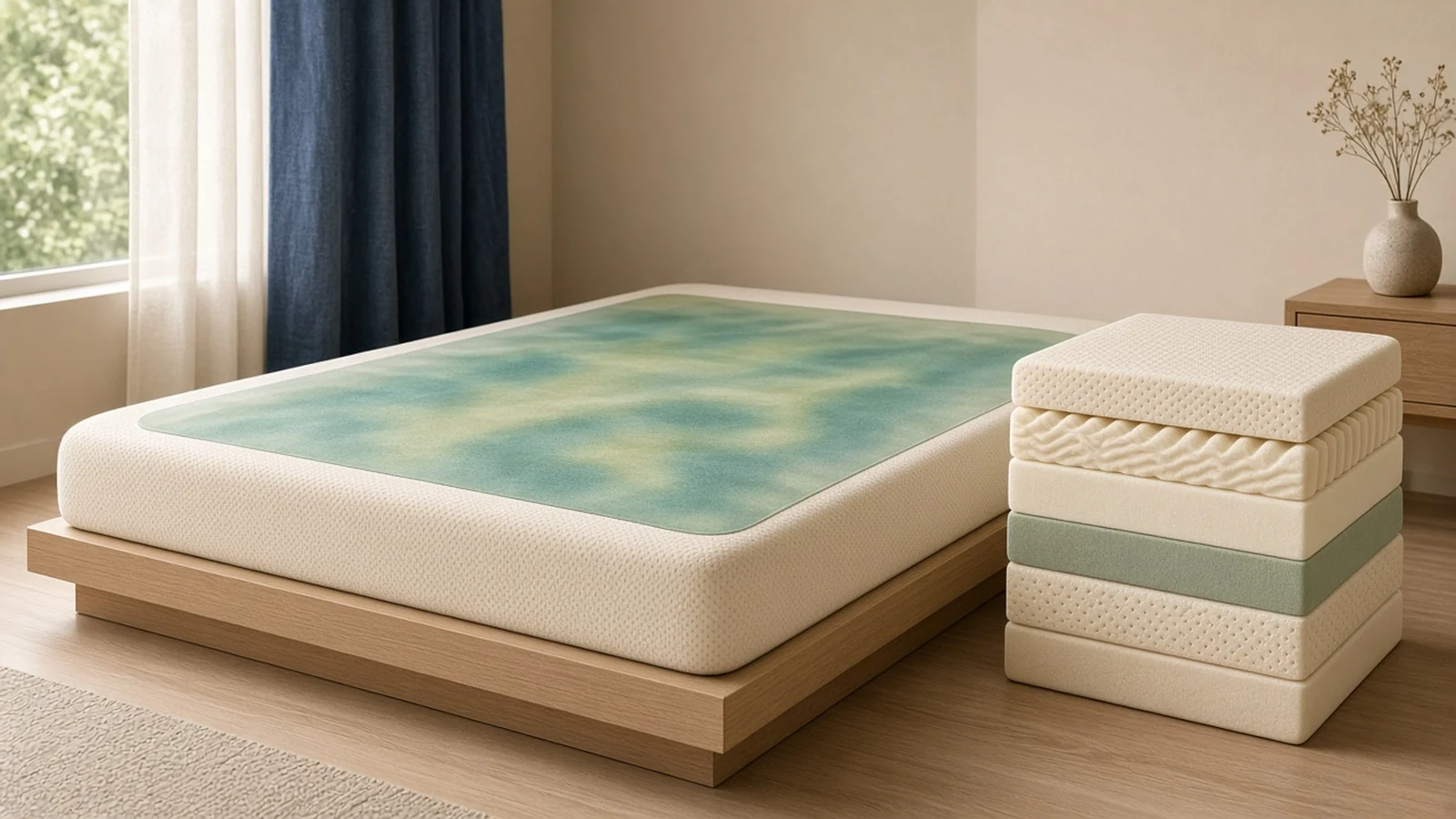
At O'Suan Sleep in Clonard, Wexford, the process is built around that measurement. The studio is appointment-only. You start with a free pressure-mapping assessment: either a pillow fitting, or a complete sleep fitting that maps how your body is supported. O'Suan says it uses a pressure-mapping mat with almost 2,000 sensors, then talks you through the results one-to-one. The company describes the visit as lasting about 15 to 30 minutes, with no obligation to buy. As the how it works page puts it, the point is clarity — what your pressure points are, and which comfort set-up is likely to suit you.
If you sleep with a partner, this is also where a configurable set-up can be discussed. O'Suan's Perfect Match system is designed so two people with different firmness needs can share a bed without defaulting to a compromise that suits neither.
What does a made-to-fit mattress look like in practice?
O'Suan was founded in County Wexford by Ray Murphy, a Triage Certified Sleep Coach, after years of seeing people choose mattresses by showroom feel rather than by what their body needed. The sleep system is configurable — internal comfort layers can be adjusted — and there is an adjustable latex pillow whose height and feel can be changed.
On the live pricing page, every mattress starts with a free sleep scan. For a standard double (4ft 6), the three ranges are currently:
- Aran Comfort: €799
- Luxury Orthopaedic: €1,299
- Premium Adjustable (natural latex, adjusted to your body): €2,299
Across all sizes, listed prices run from €599 for a single Aran Comfort to €2,599 for a super-king Premium Adjustable. The adjustable latex pillow is €189, Irish delivery is free, and old mattress removal is €50. Check the pricing page for your size; this article is not a price list.
The about page also sets out a 100-night trial and a 10-year warranty, which matters because your body may need more than one night to tell you whether a new surface is helping.
If you have a diagnosed condition and a clinician has advised a supportive mattress, you may be able to apply to Revenue for a VAT refund on certain aids and appliances. Revenue’s rules generally require medical evidence of a disability and of how the item meets your needs, plus a paid invoice showing the VAT. Revenue, not the retailer, decides the claim. O'Suan can help with the paperwork; it cannot guarantee a refund. See the VAT relief page.
When should you see a GP or physiotherapist instead of just changing the mattress?
A new mattress can be a sensible step when your bed has sagged, or when you have never had the feel matched to your body. It is not a substitute for care.
See your GP or a chartered physiotherapist if pain is persistent or getting worse, if it follows an injury, if it travels into an arm or leg, or if you have numbness, weakness, unexplained weight loss, fever, or a sudden change in bladder or bowel control. Those are reasons to get medical advice promptly, not to keep shopping.
If you would like a measured starting point rather than another guess in a showroom, book a free pressure-mapping assessment at the O'Suan studio in Clonard. Come with your partner if you share a bed. You can also read how the session works, check current prices, or look at customer results and the research O'Suan cites. Leave with a clearer picture of what your body is lying on — whether or not you decide to buy.
Questions we hear in the studio
Sources
- Caggiari et al. (2021), What type of mattress should be chosen to avoid back pain and improve sleep quality? Review of the literature, Journal of Orthopaedics and Traumatology
- Kovacs et al. (2003), Effect of firmness of mattress on chronic non-specific low-back pain, The Lancet, PubMed
- Revenue, How to reclaim VAT on aids and appliances for persons with disabilities