Sleep notes
Waking up with a stiff neck? How to choose a pillow height that fits your body
· O'Suan Sleep
In short
If you wake up with a stiff, sore neck and it eases off by lunchtime, your pillow is one of the first things worth checking. The short answer: the right pillow holds your head level with the rest of your spine in the position you actually sleep in. For most side sleepers that means a pillow tall enough to fill the gap between the mattress and your ear; for most back sleepers it means something lower and firm. The right height depends on your shoulders, your sleep position and how far you sink into your mattress, so it is worth measuring rather than guessing.
A pillow is not a treatment for neck pain. The HSE advises contacting your GP if neck pain or stiffness does not go away after a few weeks, if painkillers have not worked, if you are worried about it, or if you have other symptoms such as pins and needles, a cold arm, weakness in your arm or severe pain from your neck to your arm. If that sounds like you, start there.
Why do you wake up with a stiff neck?
According to the HSE’s neck pain guidance, one of the most common causes of neck pain is the neck becoming locked in an awkward position while sleeping. Poor posture during the day, a pinched nerve and injuries such as whiplash are on the same list, so a stiff morning neck is not always about the bed.
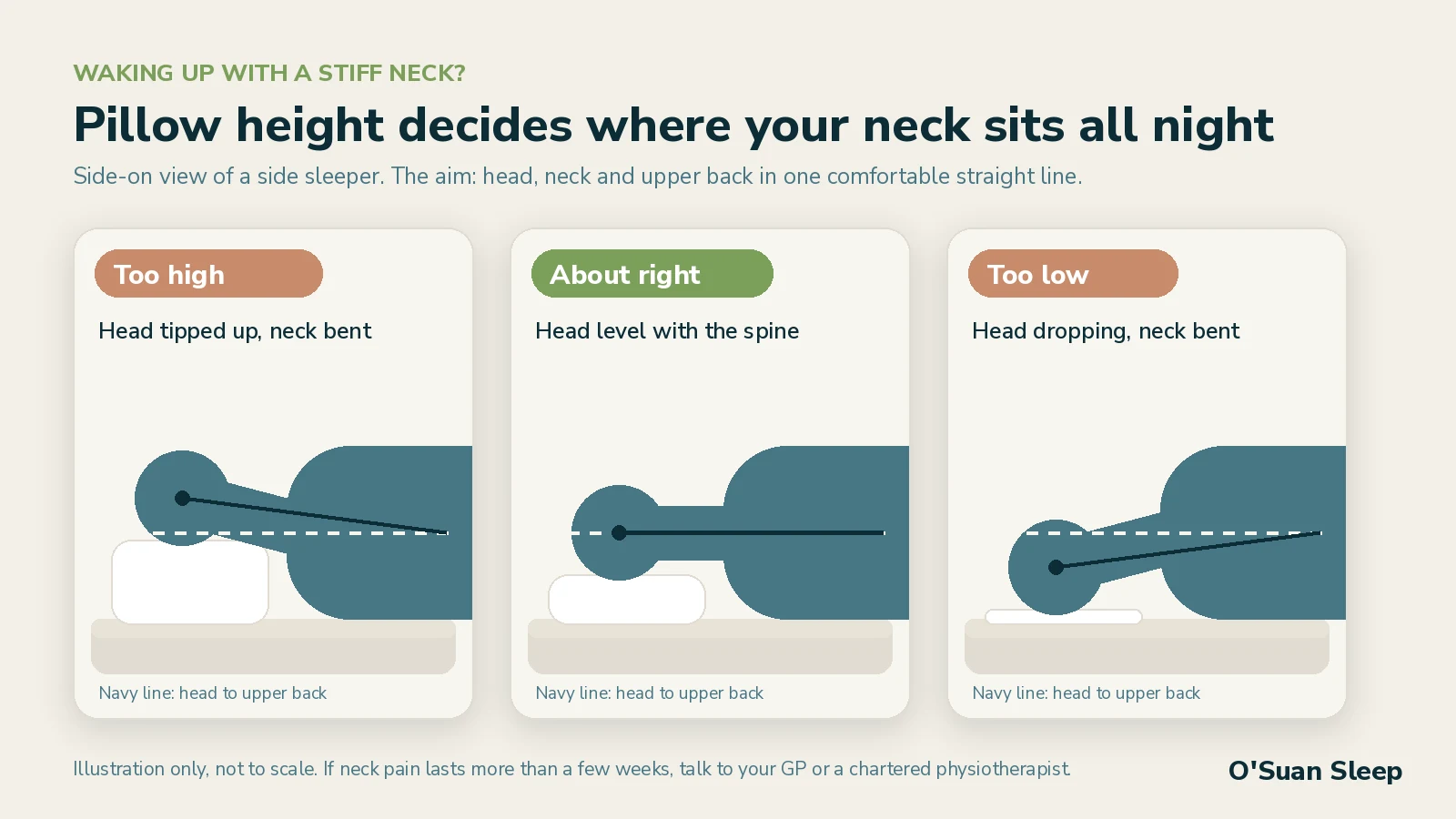
Still, you spend several hours a night with your head resting in one place. If the pillow is too high, your head is pushed up and your neck bends sideways or forwards. If it is too low, or has gone flat, your head drops towards the mattress and your neck bends the other way. The HSE’s prevention advice is simple: keep your neck in a neutral position, aligned with your spine, when you sleep, and do not sleep on your front.
You will see this question all the time from Irish people online: someone wakes up with a neck “in a jocker”, asks which pillow to buy, and gets ten different brand names back. Brand matters far less than fit. A pillow that suits your partner’s narrow shoulders can be completely wrong for your broad ones.
What pillow height is right for your sleep position?
There is no single correct height, but there is a correct job for the pillow in each position. Use this table as a starting point, not a prescription.
On your side
What the pillow needs to doFill the gap between your shoulder and your head so your nose lines up with the middle of your chest
Signs it is too highHead tipped up towards the ceiling; top shoulder and side of neck feel tight
Signs it is too lowHead drops towards the mattress; you push your arm under the pillow to prop it up
On your back
What the pillow needs to doSupport the curve of your neck without pushing your chin onto your chest
Signs it is too highChin pushed down; you wake with a tight back of the neck
Signs it is too lowHead tipped back; you wake with your jaw open or neck arched
On your front
What the pillow needs to doThe HSE advises against front sleeping for neck pain; if you cannot avoid it, a very low pillow or none
Signs it is too highNeck twisted and bent back
Signs it is too lowRarely an issue
A mix of positions
What the pillow needs to doWork for the position you spend most of the night in, with enough give to turn
Signs it is too highYou wake on your back with your chin tucked
Signs it is too lowYou wake on your side reaching for a second pillow
| Sleep position | What the pillow needs to do | Signs it is too high | Signs it is too low |
|---|---|---|---|
| On your side | Fill the gap between your shoulder and your head so your nose lines up with the middle of your chest | Head tipped up towards the ceiling; top shoulder and side of neck feel tight | Head drops towards the mattress; you push your arm under the pillow to prop it up |
| On your back | Support the curve of your neck without pushing your chin onto your chest | Chin pushed down; you wake with a tight back of the neck | Head tipped back; you wake with your jaw open or neck arched |
| On your front | The HSE advises against front sleeping for neck pain; if you cannot avoid it, a very low pillow or none | Neck twisted and bent back | Rarely an issue |
| A mix of positions | Work for the position you spend most of the night in, with enough give to turn | You wake on your back with your chin tucked | You wake on your side reaching for a second pillow |
Notice that side sleeping usually needs the most height, because your shoulder holds your body up off the mattress. The HSE’s self-care advice for easing neck pain mentions a low, firm pillow; for a side sleeper, “low” still has to be high enough to keep the head level, which is why shoulder width matters so much.
Research on side sleepers points the same way. A small 2025 study by Tian and colleagues in Medical & Biological Engineering & Computing tested latex pillows at four heights on nine healthy adults lying on their side. Neck alignment was well predicted by a pillow height adjusted for each person’s shoulder width, and a medium individualised height with neck support gave the curve closest to natural standing posture. With only nine people, it is a pointer rather than proof, but it supports the idea behind a fitting: one height does not suit everyone.
Does your mattress change the pillow you need?
Yes, and this is the part most pillow advice leaves out. Lying on your side, your shoulder sinks into the mattress. On a soft mattress it sinks further, which shrinks the gap the pillow has to fill. On a firm mattress your shoulder stays higher, so you need more pillow height. Buy a pillow that felt perfect on a firm showroom bed, bring it home to a softer or sagging mattress, and it can suddenly be too high.
That is why it makes sense to look at your pillow and mattress together. At O’Suan Sleep, the Complete Sleep Fitting uses a pressure-mapping mat with almost 2,000 sensors to see how your shoulders, hips and back are supported, and the pillow is set up around that. If you suspect your mattress is part of the problem, you can see how our fitting process works before you book.
Is a latex pillow better for neck pain than memory foam or feathers?
The honest answer is that the evidence is mixed, and anyone promising a cure is overselling.
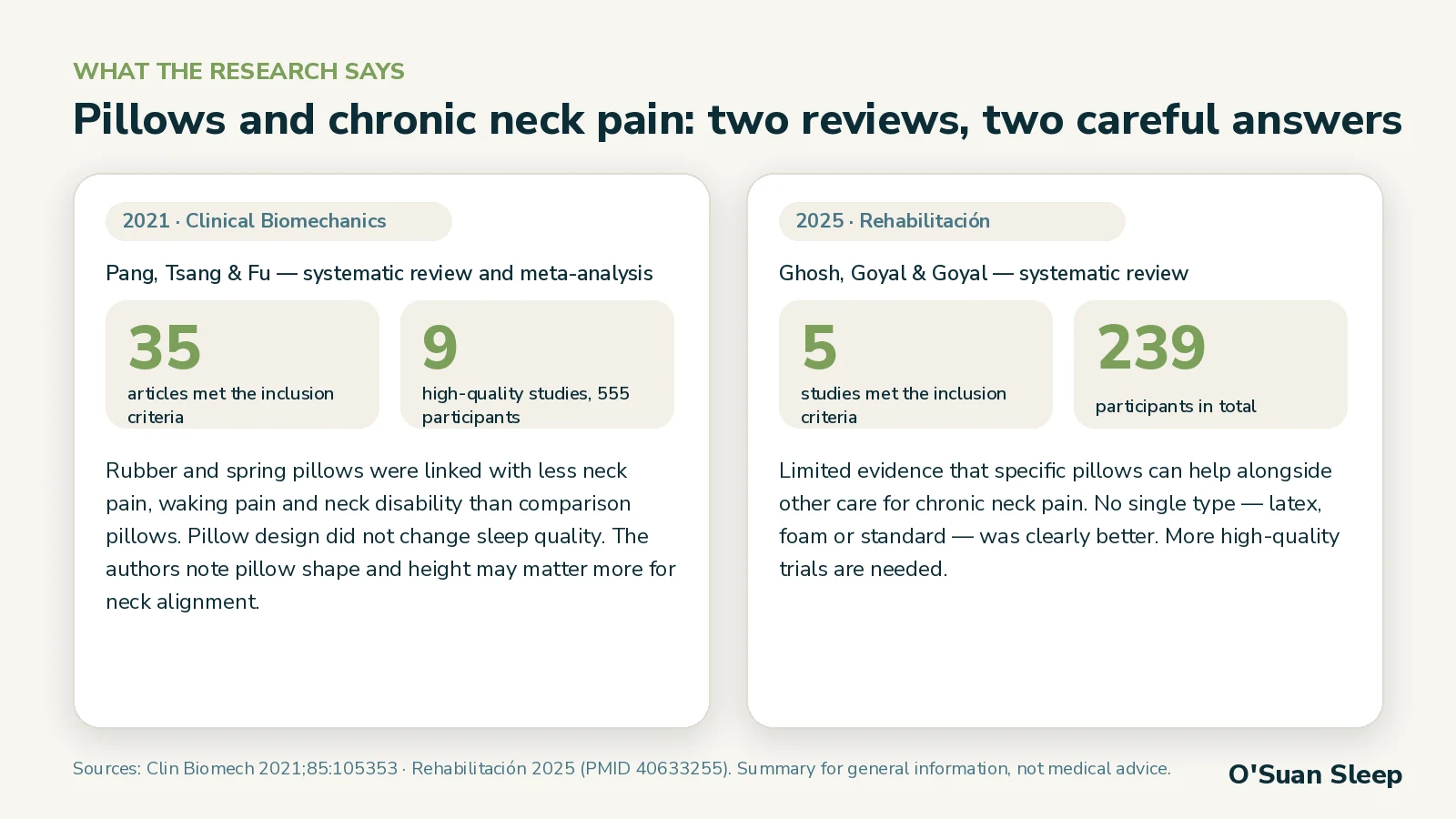
A 2021 systematic review and meta-analysis by Pang, Tsang and Fu in Clinical Biomechanics found 35 relevant articles, including nine high-quality studies with 555 participants. Pooled results favoured rubber pillows (the family natural latex belongs to) for reducing neck pain, and rubber and spring pillows for reducing waking pain and neck disability. Pillow design did not improve sleep quality, and the authors suggested the shape and height of the pillow may matter more for neck alignment than the material.
A more recent systematic review by Ghosh, Goyal and Goyal, published in Rehabilitación in 2025, looked at five studies with 239 people with chronic neck pain. It found limited evidence that specific pillows can help as an addition to other care, and no clear winner between latex, foam and standard pillows.
Put together, material is a matter of feel and durability more than a magic ingredient. Latex is springy and holds its shape, memory foam moulds slowly, and feathers can be plumped but tend to flatten during the night. What the research keeps coming back to is fit: height and shape for your body and position.
How can you check your pillow at home tonight?
You do not need any equipment for a quick check. Ask someone to help:
- Lie in your usual sleep position on your normal mattress and pillow, and stay there for a minute or two so you settle.
- Have your helper look at you side-on (for back sleeping) or from behind (for side sleeping).
- Check whether the middle of your head lines up with the middle of your upper back, or whether your head is tipped up or dropping down.
- Fold the pillow in half. If it does not spring back, it has probably lost its support.
- Notice whether you sleep with an arm under the pillow, or wake up having pushed the pillow away. Both suggest the height is wrong.
If a new pillow does change your alignment, give your neck a short time to adjust. Writing for Natural Back Health, an Irish back-care practice, the author suggests allowing a couple of days to settle and reconsidering if you are not settling after a week or two.
What happens at a free pillow fitting at O’Suan Sleep?
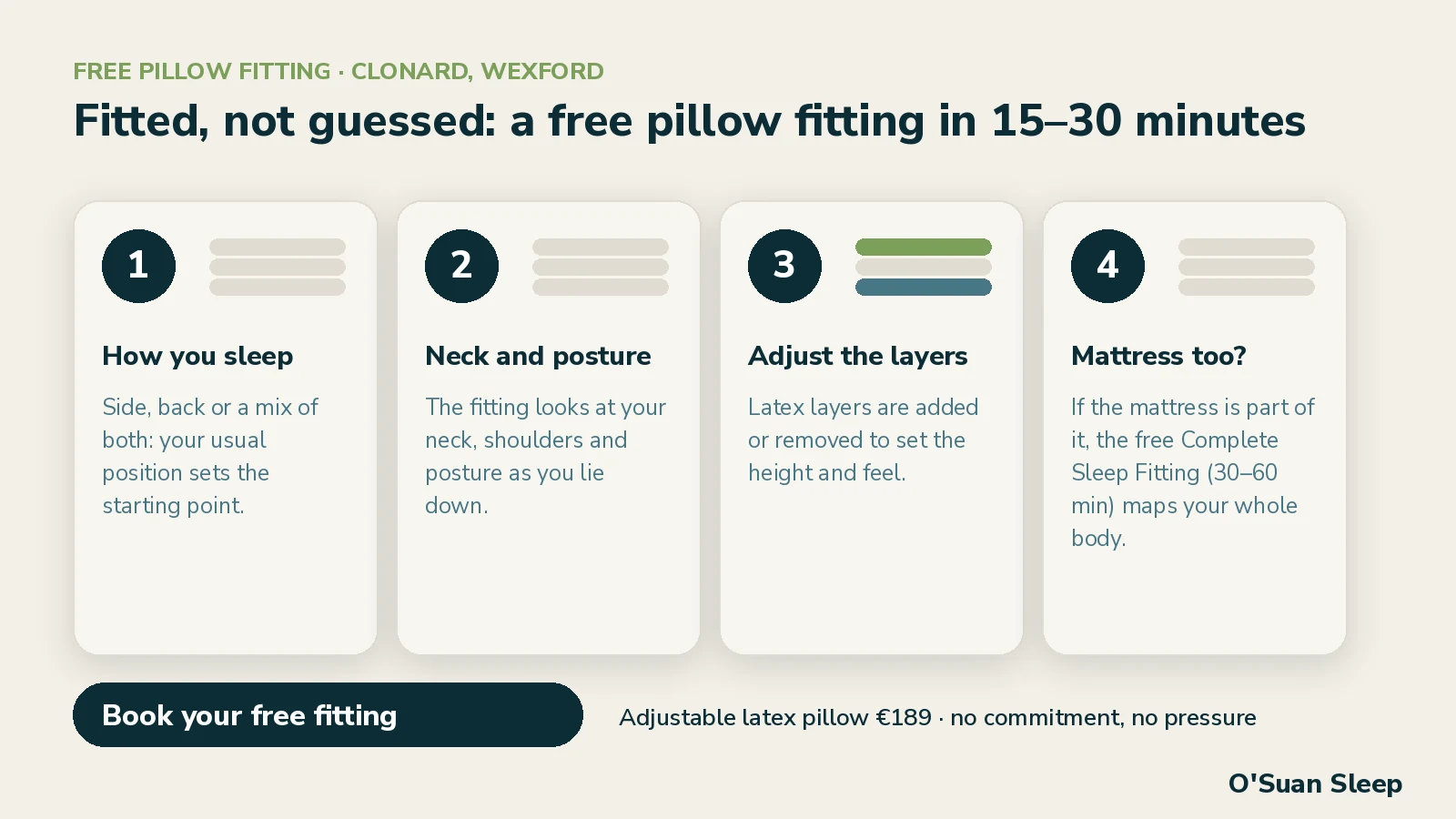
O’Suan Sleep is an appointment-only sleep studio in Clonard, Co. Wexford, run by founder and sleep coach Ray Murphy. We offer two free fittings:
- Pillow Fitting (about 15–30 minutes): a personalised fitting to shape our adjustable latex pillow around your neck, posture and sleep position.
- Complete Sleep Fitting (about 30–60 minutes): a full-body pressure-mapping scan that looks at how you sleep and builds the mattress-and-pillow system around it.
Our adjustable latex contour pillow lets you add or remove layers to set your height and feel, and it costs €189 (see our pricing page). Booking is no commitment, no pressure. If you would like to talk first, you can call Ray directly from our contact page, or read more about the studio itself.
When should you see a GP or physiotherapist instead?
A pillow can make your nights more comfortable, but it should not delay getting checked. Following the HSE’s guidance, contact your GP if:
- neck pain or stiffness does not go away after a few weeks
- painkillers like paracetamol or ibuprofen have not helped
- you are worried about the pain
- you have pins and needles, a cold arm, weakness in your arm, or severe pain spreading from your neck to your arm
A chartered physiotherapist can also help with exercises and posture during the day, which the HSE lists among the most common causes of neck pain.
Ready to stop guessing?
If you keep waking up stiff, book a free pressure-mapping assessment: either the 15–30 minute pillow fitting or the full sleep fitting. We will show you what we measure, explain it in plain language, and you can decide in your own time. Book your free pressure-mapping assessment.
Questions we hear in the studio
Sources
- HSE, Neck pain (reviewed 03/03/2026)
- Pang JCY, Tsang SMH, Fu ACL. The effects of pillow designs on neck pain, waking symptoms, neck disability, sleep quality and spinal alignment in adults: a systematic review and meta-analysis. Clin Biomech 2021;85:105353
- Ghosh S, Goyal M, Goyal K. Effect of pillow on pain, disability and sleep quality in patients with chronic neck pain: a systematic review. Rehabilitación 2025
- Tian S et al. The individualized optimal pillow height and neck support design for side sleepers. Med Biol Eng Comput 2025
- Natural Back Health, Need a new pillow? Here are some pointers