Sleep notes
Memory foam, latex, pocket sprung or hybrid? How to choose a mattress type for your body
· O'Suan Sleep
In short
Short answer: no single type is best for everybody. Memory foam hugs the body and relieves pressure, latex is bouncier, more temperature-neutral and usually lasts longer, pocket springs breathe well, and a hybrid puts a thick comfort layer on top of springs. The Sleep Foundation’s view is that no one type of mattress is the best in all cases. If you wake up sore, the research points less at the material and more at the result: a mattress that feels medium-firm for your body and supports your spine the way you actually sleep.
A quick note first: a mattress is not a treatment for pain. The HSE advises contacting a GP if back pain does not start to improve within a few weeks, stops you doing everyday activities, is very severe or gets worse, or causes you worry or distress.
What are the main types of mattress?
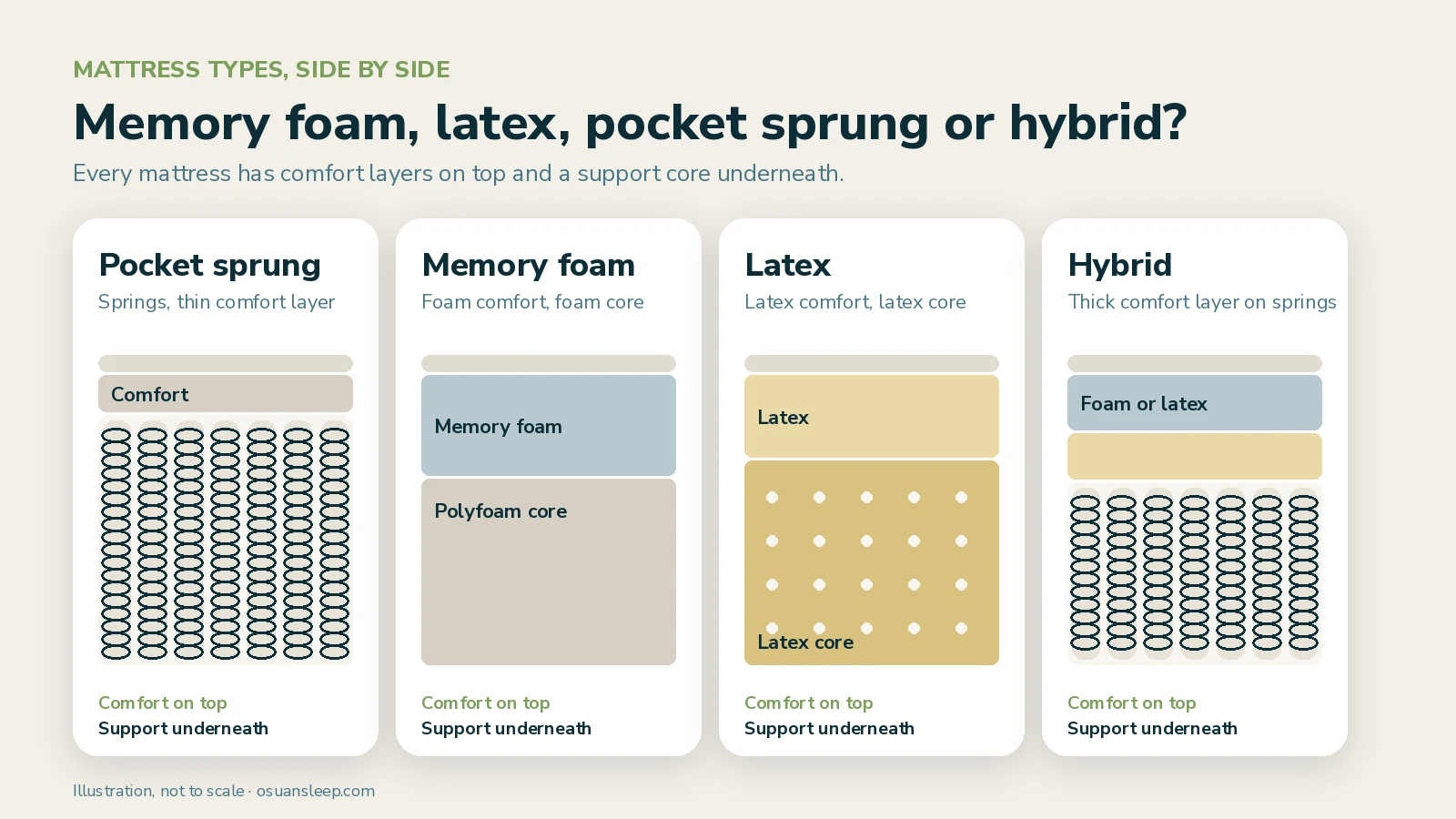
This guide covers the four most people weigh up: pocket sprung (and other spring beds), memory foam, latex and hybrid. The Sleep Foundation groups almost every mattress on the market into five categories, innerspring, foam, hybrid, latex and airbed, based on how it is built and what it is made of.
Every mattress has two parts. The Sleep Foundation explains that the comfort system is mainly responsible for firmness, while the core plays a bigger role in support. So the name on the label only tells you part of the story.
- Pocket sprung: a spring unit where each coil sits in its own fabric pocket, so the springs can move more independently than in a traditional sprung bed.
- Memory foam: a polyurethane foam that softens with body heat and slowly moulds to your shape.
- Latex: a foam made from the sap of rubber trees, or a synthetic version, with a springy, responsive feel.
- Hybrid: a spring support core, usually pocketed coils, with a substantial comfort layer of foam, latex or fibres on top.
How do memory foam, latex, pocket sprung and hybrid compare?
Each type trades one strength for another. This summary is drawn from the Sleep Foundation’s guide to mattress types and its comparison of memory foam and latex:
Pocket sprung / innerspring
How it feelsBouncy and responsive; traditional sprung beds have only a thin comfort layer
Usually good atAirflow, bounce and edge support; pocketed coils move more independently
Watch out forLittle pressure relief without a thicker comfort layer; more motion transfer
Memory foam
How it feelsDeep, body-hugging feel that responds slowly
Usually good atPressure relief and motion isolation
Watch out forCan trap heat; may have too much give for heavier sleepers; can sag over time
Latex
How it feelsBouncy, springy, moderate contouring
Usually good atDurability, temperature neutrality, easy to move on
Watch out forCosts more; transfers more motion than memory foam; heavy
Hybrid
How it feelsDepends on the comfort layers over the springs
Usually good atBalanced feel, bounce and temperature regulation
Watch out forCosts more; heavier; more motion than most foam beds
| Type | How it feels | Usually good at | Watch out for |
|---|---|---|---|
| Pocket sprung / innerspring | Bouncy and responsive; traditional sprung beds have only a thin comfort layer | Airflow, bounce and edge support; pocketed coils move more independently | Little pressure relief without a thicker comfort layer; more motion transfer |
| Memory foam | Deep, body-hugging feel that responds slowly | Pressure relief and motion isolation | Can trap heat; may have too much give for heavier sleepers; can sag over time |
| Latex | Bouncy, springy, moderate contouring | Durability, temperature neutrality, easy to move on | Costs more; transfers more motion than memory foam; heavy |
| Hybrid | Depends on the comfort layers over the springs | Balanced feel, bounce and temperature regulation | Costs more; heavier; more motion than most foam beds |
Keep in mind that most modern mattresses mix materials. The Sleep Foundation advises judging a multi-layer mattress on its construction as a whole rather than on one material.
Is memory foam or latex better for back pain?
There is no clear winner for back pain. The main research reviews sorted mattresses by firmness rather than material, and they have tended to favour medium-firm.
In a randomised, double-blind trial published in The Lancet in 2003, 313 adults with chronic non-specific low back pain were given either a firm or a medium-firm mattress. After 90 days, the medium-firm group had better results for pain while lying in bed and for disability. A 2015 systematic review of 24 controlled trials found a medium-firm, self-adjusted mattress was best for sleep comfort, sleep quality and spinal alignment, and a 2021 systematic review of 39 articles reached a similar conclusion for medium-firm mattresses.
Material does change how that support feels. The Sleep Foundation says both memory foam and latex can be very supportive, that most people find memory foam gives the best pressure relief, and that over the long run latex typically holds its support better because memory foam will eventually start to sag.
One small study measured the difference. Researchers at the National University of Singapore had 20 people lie on a latex and a polyurethane foam mattress in three postures on a pressure mat; the latex mattress reduced peak pressure on the torso and buttocks and spread pressure more evenly. With so few people, treat it as a pointer rather than proof.
For more on this, see our guide to choosing a mattress when you wake up with back pain.
Which mattress type suits your sleep position?
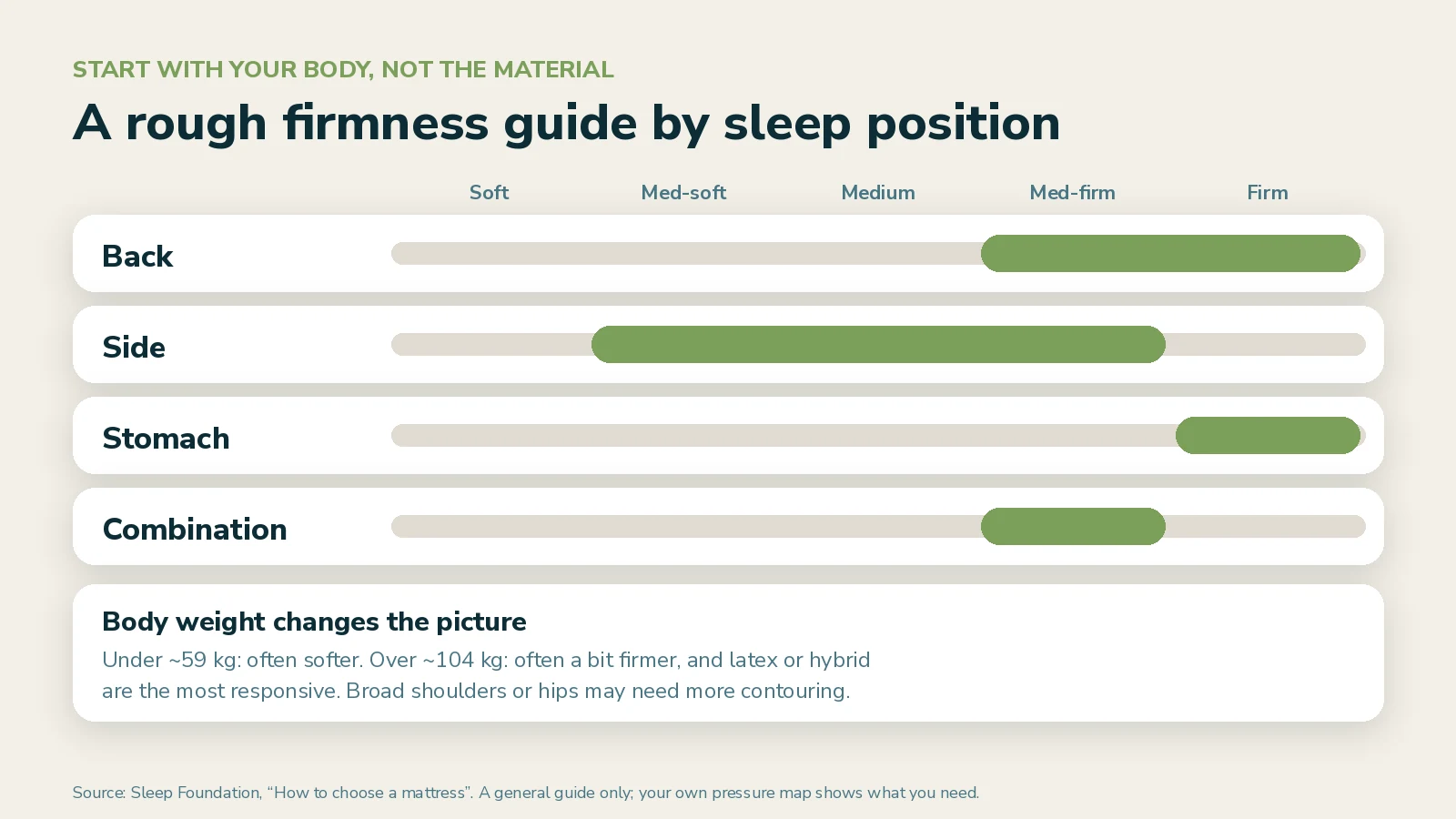
Your sleep position matters more than the material, because it decides where your body needs support and where it needs cushioning. The Sleep Foundation’s general guidance on firmness by position is:
- Back sleepers: medium-firm to firm, with light to moderate contouring, so the lower back neither sags nor goes unsupported.
- Side sleepers: medium-soft to medium-firm, because the shoulders and hips are pressure points that need to sink in a little without dropping out of line.
- Stomach sleepers: usually firm, to keep the body out of a U-shape.
- Combination sleepers: choose for the position you spend most time in; if there is none, medium-firm and a responsive surface that makes it easy to move.
For side sleepers, the material question often comes down to contouring: the Sleep Foundation rates memory foam high for contouring and latex low to medium. Your pillow matters too; see our guide to choosing a pillow height that fits your body.
Does your body weight change which type you should choose?
Yes. Heavier and lighter bodies sink into the same mattress very differently, so the same type can feel quite different from one person to the next.
The Sleep Foundation says people under about 59 kg (130 lb) don’t sink as far and often benefit from a softer mattress, with foam or hybrid beds as good options and innerspring beds tending to be a poor fit. Between about 59 and 104 kg (130 to 230 lb), follow the guidance by sleep position; foam, hybrid and latex are all solid options. Over about 104 kg (230 lb), a slightly firmer mattress usually works better, and latex and hybrids tend to be the most responsive, so it is easier to move.
It notes that memory foam can have too much give for heavier sleepers, and that latex tends to perform better for them. Shape matters as well as weight: people with broader shoulders or hips may need more contouring, especially if they sleep on their side.
How long does each type of mattress last?
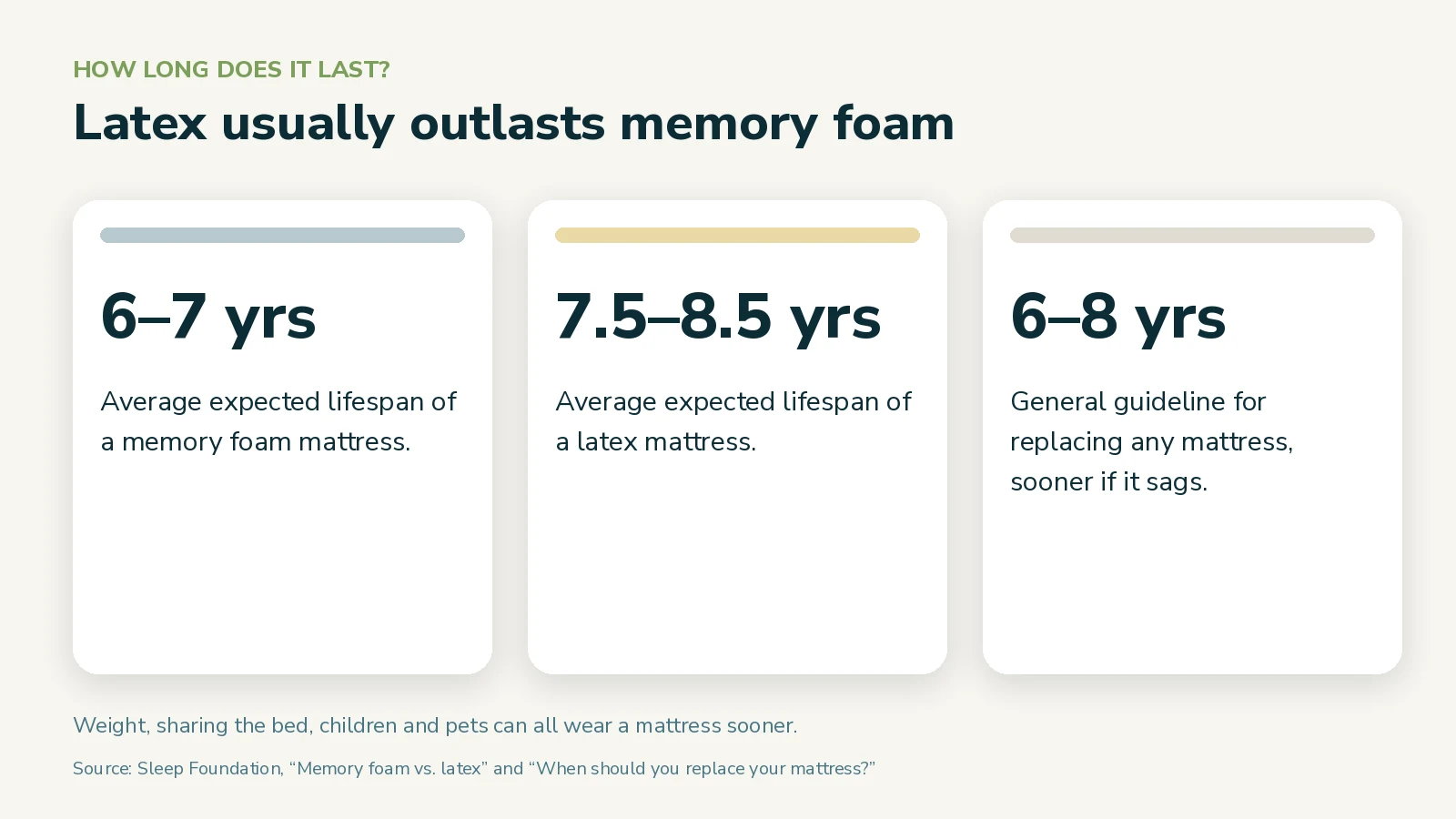
Latex usually lasts longest, and lower-quality spring and all-foam mattresses tend to wear out soonest. How you use it matters too: the Sleep Foundation says heavier sleepers, couples, and children or pets sharing the bed can all wear a mattress out sooner.
The Sleep Foundation’s general guideline is to replace a mattress every 6 to 8 years under normal conditions. It says lower-quality innerspring and all-foam mattresses tend to have the shortest lifespans, hybrids tend to be more durable because they are often made with higher-quality materials, and latex mattresses are the most durable, lasting upwards of 8 years. On average, it puts the expected lifespan of a latex mattress at around 7.5 to 8.5 years, compared with 6 to 7 years for memory foam.
Why does the fit matter more than the type?
Because two mattresses of the same type can feel completely different. What counts is how your own body lies on it.
The Sleep Foundation notes there is no universally accepted way to measure mattress firmness, so each manufacturer may use its own scale. One brand’s medium-firm can feel like another’s firm.
That is the gap pressure mapping fills. At our studio in Clonard, Co. Wexford, we use a pressure-mapping mat with almost 2,000 sensors to measure how your body is supported when you lie down. It shows the areas of higher pressure around your shoulders, hips and lower back, and that guides how the comfort layers are set up for you. Our system is built so the internal comfort layers can be adjusted to give targeted support where you need it.
Our three ranges cover different needs: Aran Comfort offers targeted pressure relief, Luxury Orthopaedic gives firm support with two comfort options, and Premium Adjustable uses natural latex with adjustable comfort layers. Prices run from €599 for a single in Aran Comfort to €2,599 for a super king in Premium Adjustable. Delivery is free and old mattress removal is €50. Full details are on our pricing page.
When should you see a GP or physio instead?
If pain is persistent, severe or getting worse, see a GP first. Changing your mattress is no substitute for proper advice.
The HSE says to contact a GP straight away if you have back pain along with signs such as pain that gets worse at night or stops you sleeping, numbness or tingling around your genitals or bottom, problems peeing, a high temperature, or unexplained weight loss. You can also contact a physiotherapist directly for exercises. The HSE does list “check that your mattress supports you properly” among the things that can help keep your back strong.
Book your free pressure-mapping assessment
Rather than choosing between memory foam, latex or springs on a hunch, see what your body actually needs. Book a free pressure-mapping assessment at our appointment-only studio in Clonard, choose a pillow fitting or a complete sleep fitting, and you will see your own pressure map before you decide anything. There is no pressure to buy. Book your free pressure-mapping assessment.
Questions we hear in the studio
Sources
- Sleep Foundation. Memory foam vs. latex. Fetched 23 Nov 2026.
- Sleep Foundation. Mattress types. Fetched 23 Nov 2026.
- Sleep Foundation. How to choose a mattress: finding your perfect match. Fetched 23 Nov 2026.
- Sleep Foundation. Mattress firmness. Fetched 23 Nov 2026.
- Sleep Foundation. When should you replace your mattress? Fetched 23 Nov 2026.
- Kovacs FM et al. Effect of firmness of mattress on chronic non-specific low-back pain. The Lancet, 2003. PubMed 14630439.
- Radwan A et al. Effect of different mattress designs on promoting sleep quality, pain reduction, and spinal alignment. Sleep Health, 2015. PubMed 29073401.
- Caggiari G et al. What type of mattress should be chosen to avoid back pain and improve sleep quality? J Orthop Traumatol, 2021. PubMed 34878594.
- Low FZ et al. Effects of mattress material on body pressure profiles in different sleeping postures. J Chiropr Med, 2017. PubMed 28228692.
- HSE. Back pain: causes and treatment. Fetched 23 Nov 2026.
- Revenue. How to reclaim VAT on aids and appliances for persons with disabilities. Fetched 23 Nov 2026.