Sleep notes
Do you need an orthopaedic mattress? What the label really means, and what to check instead
· O'Suan Sleep
In short
Short answer: not necessarily. “Orthopaedic” is not a regulated word for mattresses, and there are no standards or certifications behind it, according to the Sleep Foundation. So the label on its own tells you very little. What matters if you wake up sore is whether a mattress keeps your spine supported while easing pressure at your shoulders and hips, and the research on people with low back pain has tended to favour medium-firm over very firm. The only way to know what suits you is to check how your own body lies on it.
A quick note before we start: a mattress is not a treatment for pain. The HSE advises contacting a GP if back pain does not start to improve within a few weeks, stops you doing your everyday activities, is very severe or gets worse, or causes you worry or distress. If that sounds like you, start there.
What does “orthopaedic mattress” actually mean?
It usually means a mattress sold as extra supportive, but there is no agreed standard behind the word. The Sleep Foundation points out that there are no regulations or standards defining what qualifies as an orthopaedic mattress, so the term is often used for marketing whether or not a mattress is specially designed for support, and shoppers essentially have to take the manufacturer at their word.
The word itself comes from orthopaedics, the branch of medicine that deals with bones, joints, muscles, ligaments and tendons. It does not, on its own, tell you how a mattress will treat your body.
In fairness, we use the word too. One of our three mattress ranges is called Luxury Orthopaedic, described on our pricing page as firm support with two comfort options. The name tells you what that range is built for. It does not tell you whether it is right for you, which is why every mattress we sell starts with a free sleep scan.
Is an orthopaedic mattress better for back pain?
Not because of the label. The best evidence available points towards a medium-firm mattress rather than a very firm one for people with low back pain, though no single firmness suits everybody.
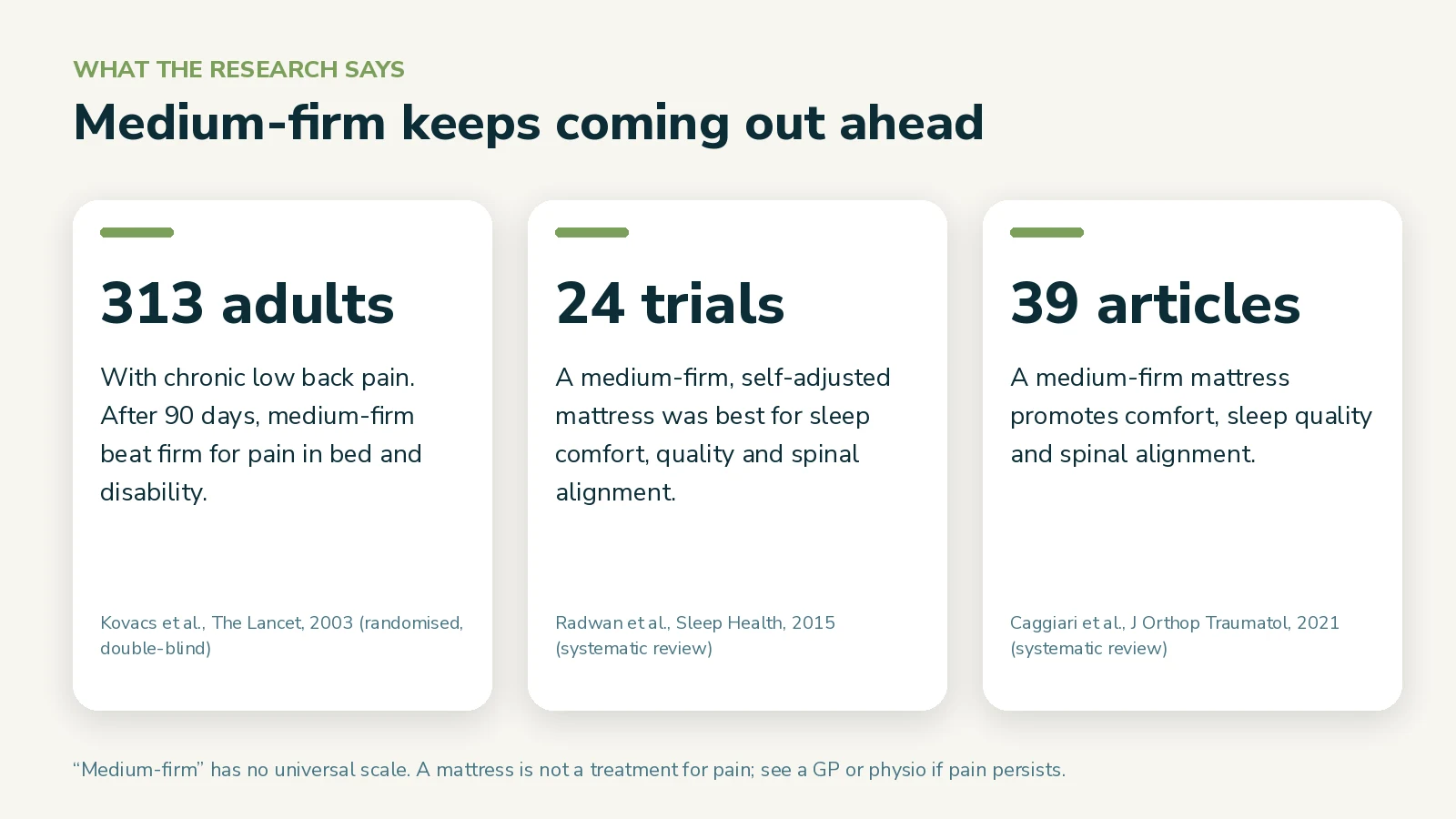
The best-known study is a randomised, double-blind trial published in The Lancet in 2003. Researchers gave 313 adults with chronic non-specific low back pain either a firm or a medium-firm mattress. After 90 days, the medium-firm group had better results for pain while lying in bed and for disability, and across the study period they reported less pain on getting up.
Two reviews of the research have come to a similar view. A 2015 systematic review of 24 controlled trials in the journal Sleep Health found that a mattress described as medium-firm and custom inflated (self-adjusted) was best for sleep comfort, sleep quality and spinal alignment. A 2021 systematic review of 39 articles in the Journal of Orthopaedics and Traumatology concluded that a medium-firm mattress promotes comfort, sleep quality and spinal alignment.
One catch: “medium-firm” is not a fixed measurement. The Sleep Foundation notes that there is no universally accepted way to measure mattress firmness, so each manufacturer may use its own scale. One brand’s medium-firm may not match another’s.
Is firmness the same as support?
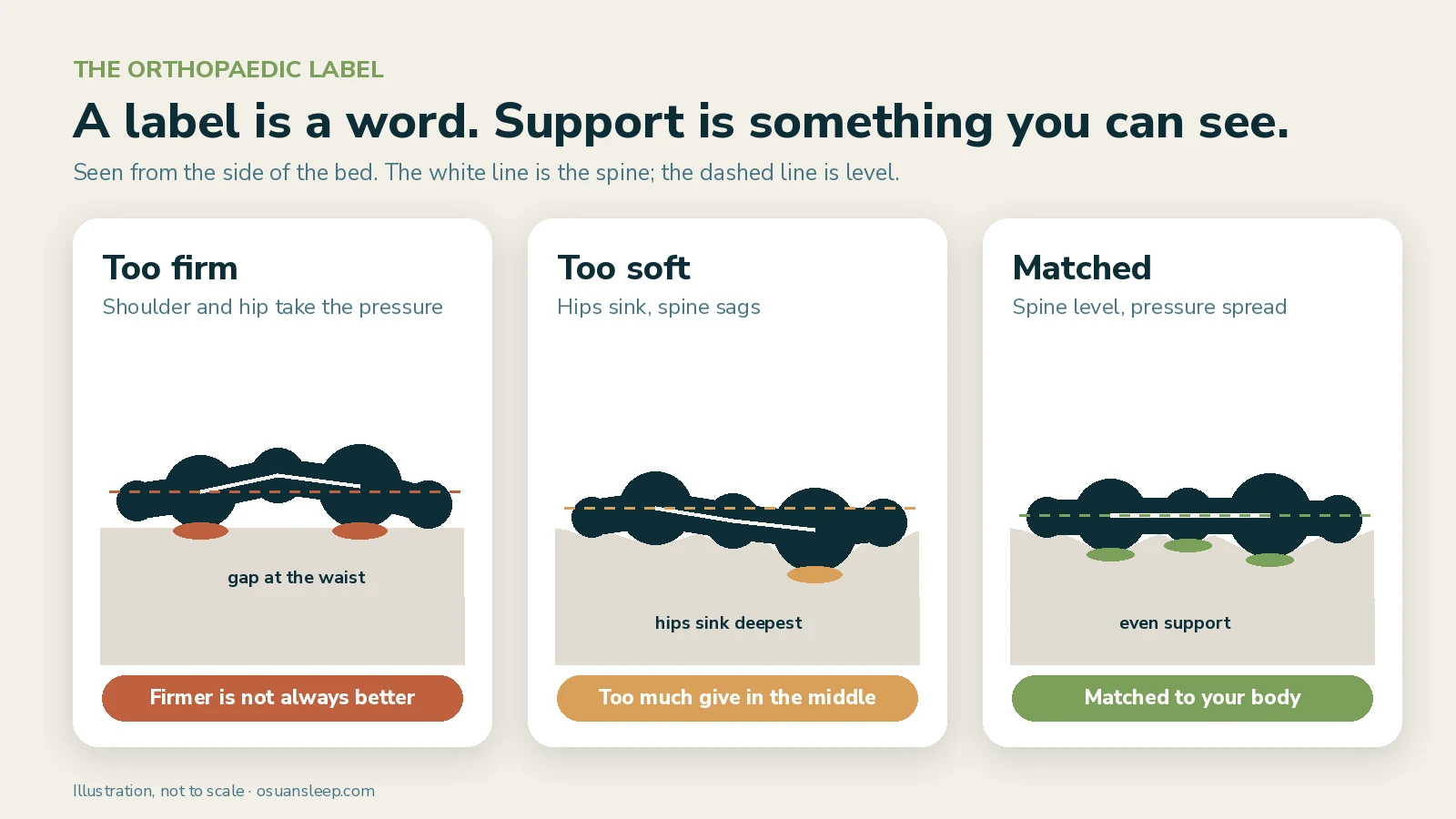
No. Firmness is how hard or soft a mattress feels; support is whether it keeps your spine in good alignment. The Sleep Foundation notes that shoppers often confuse the two.
The Sleep Foundation explains that firmness comes mainly from the comfort layers, while support comes mainly from the mattress core. That means a mattress can be soft and supportive, or firm and unsupportive. It also says no one firmness level works best for all sleepers, because your weight, body type and usual sleep position all change what feels comfortable and supportive.
What an “orthopaedic” label might suggest, and what to check instead:
Firm means supportive
What to check insteadWhether your spine stays level in your usual sleep position
Why it mattersFirmness and support are separate: a mattress can be soft and supportive, or firm and unsupportive (Sleep Foundation)
Good for back pain
What to check insteadWhether it feels medium-firm for your body
Why it mattersMedium-firm beat firm for chronic low back pain in a 313-person trial (Kovacs, The Lancet, 2003)
One feel suits everyone
What to check insteadYour weight, body shape and sleep position
Why it mattersNo one firmness level works best for all sleepers (Sleep Foundation)
Built for life
What to check insteadThe age and condition of your current mattress
Why it mattersGeneral guideline is to replace every 6 to 8 years, sooner if it sags (Sleep Foundation)
A certified standard
What to check insteadWhat has actually been measured on your body
Why it mattersThere are no standards or certifications for orthopaedic mattresses (Sleep Foundation)
| What the label might suggest | What to check instead | Why it matters |
|---|---|---|
| Firm means supportive | Whether your spine stays level in your usual sleep position | Firmness and support are separate: a mattress can be soft and supportive, or firm and unsupportive (Sleep Foundation) |
| Good for back pain | Whether it feels medium-firm for your body | Medium-firm beat firm for chronic low back pain in a 313-person trial (Kovacs, The Lancet, 2003) |
| One feel suits everyone | Your weight, body shape and sleep position | No one firmness level works best for all sleepers (Sleep Foundation) |
| Built for life | The age and condition of your current mattress | General guideline is to replace every 6 to 8 years, sooner if it sags (Sleep Foundation) |
| A certified standard | What has actually been measured on your body | There are no standards or certifications for orthopaedic mattresses (Sleep Foundation) |
Could your current mattress be the problem, whatever it was called?
Sometimes, yes. An older mattress that has started to sag gives less support, whatever label it had when you bought it.
The Sleep Foundation’s general guideline is to replace a mattress every 6 to 8 years under normal conditions, and sooner if it is noticeably saggy or damaged, if you sleep better in hotels or at friends’ houses, or if you regularly wake up with muscle or joint stiffness. It explains that older beds tend to sag in places, which reduces support and makes it less likely your spine is properly aligned.
Researchers at Oklahoma State University tested this in two small studies. In a 2009 study, 59 healthy adults with minor sleep-related aches recorded their sleep for four weeks in their own beds, which averaged 9.5 years old, and then for four weeks on new medium-firm beds. Sleep quality improved significantly and back discomfort went down. An earlier study of 62 people found improvements in back and shoulder pain and sleep quality on new medium-firm beds, and lower back pain was more common among people on the cheapest beds. Both compared people with themselves before and after, without a separate control group, so treat them as useful pointers rather than proof.
A few quick checks you can do at home:
- How old is the mattress? If it is past 6 to 8 years, it may be due a change.
- Can you see or feel a dip where you usually lie?
- Do you regularly wake up stiff, or sleep better away from home?
Latex, foam or springs: does the material make a mattress orthopaedic?
No material is automatically orthopaedic. What matters is how the layers work together to support your particular body.
Material does affect how long a mattress keeps its shape. The Sleep Foundation says lower-quality innerspring and all-foam mattresses tend to have the shortest lifespans, because they are prone to sagging and body impressions, and that latex mattresses are the most durable, lasting upwards of 8 years.
Our Premium Adjustable range uses natural latex with adjustable comfort layers. More broadly, the O’Suan system is built so the internal comfort layers can be adjusted to give support where your body needs it, rather than relying on one fixed feel.
What should you check before buying a mattress labelled orthopaedic?
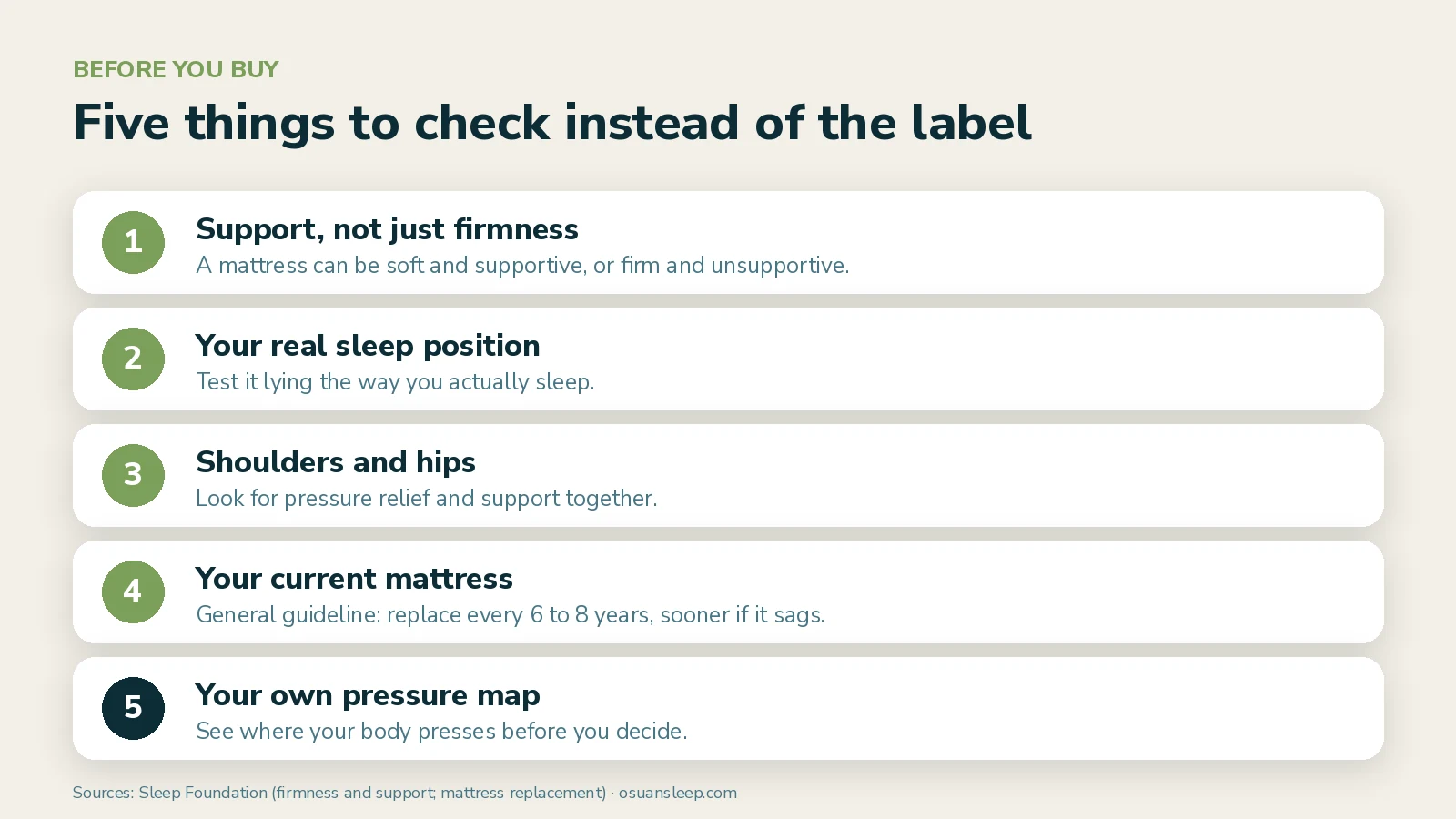
Check how your body lies on it, not the word on the tag. These questions will tell you far more than the label:
- Ask what is actually inside it. Support comes mainly from the core and feel from the comfort layers, so ask what each is made of.
- Lie in the position you really sleep in. If you sleep on your side, test it on your side, not just flat on your back for a minute.
- Look for support and pressure relief together. The Sleep Foundation says a good orthopaedic mattress should combine pressure relief with support to help keep your spine aligned.
- Do not assume the firmest is best. In the Lancet trial, medium-firm did better than firm for people with chronic low back pain.
- Be careful comparing firmness numbers between brands. There is no universal firmness scale.
- If you have a diagnosed condition, ask about VAT relief before you buy, and keep your invoice.
How does pressure mapping take the guesswork out?
Pressure mapping measures where your body presses into the mattress, so the choice is based on your own results rather than a label or a quick lie-down.
At our studio in Clonard, Co. Wexford, we use a pressure-mapping mat with almost 2,000 sensors to measure how your body is supported when you lie down. It shows areas of higher pressure around the shoulders, hips and lower back, and that guides how the comfort layers are set up for you. You leave with a clear picture of your pressure points and support needs, and a recommendation based on measurement.
The studio is appointment-only and one-to-one, with no pressure to buy. Our mattresses range from €599 for a single in the Aran Comfort range to €2,599 for a super king in the Premium Adjustable range, and a double in the Luxury Orthopaedic range is €1,299. Delivery is free, and removal of your old mattress is €50. Full details are on our pricing page.
When should you see a GP or physio instead?
If your pain is persistent, severe or getting worse, see a GP first. A mattress is no substitute for proper advice.
The HSE says to contact a GP if back pain does not start to improve within a few weeks, stops you doing everyday activities, is very severe or gets worse over time, or causes you worry or distress. It says to contact a GP straight away if you have back pain along with signs such as pain that gets worse at night or stops you sleeping, numbness or tingling around your genitals or bottom, problems peeing, a high temperature, or unexplained weight loss. You can also contact a physiotherapist directly for exercises.
The HSE does list “check that your mattress supports you properly” among the things that can help keep your back strong, alongside staying active, aiming for at least 150 minutes of activity a week, and not sitting for long periods.
Book your free pressure-mapping assessment
If you are weighing up an orthopaedic mattress, find out what your body actually needs first. Book a free pressure-mapping assessment at our Clonard studio, choose a pillow fitting or a complete sleep fitting, and you will see your own pressure map before you decide anything. Book your free pressure-mapping assessment.
Questions we hear in the studio
Sources
- Sleep Foundation. Best orthopedic mattress (section: What is an orthopedic mattress?). Fetched 18 Nov 2026.
- Sleep Foundation. Mattress firmness: finding the best firmness for you. Fetched 18 Nov 2026.
- Sleep Foundation. When should you replace your mattress? Fetched 18 Nov 2026.
- Kovacs FM et al. Effect of firmness of mattress on chronic non-specific low-back pain. The Lancet, 2003. PubMed 14630439.
- Radwan A et al. Effect of different mattress designs on promoting sleep quality, pain reduction, and spinal alignment. Sleep Health, 2015. PubMed 29073401.
- Caggiari G et al. What type of mattress should be chosen to avoid back pain and improve sleep quality? J Orthop Traumatol, 2021. PubMed 34878594.
- Jacobson BH et al. Changes in back pain, sleep quality, and perceived stress after introduction of new bedding systems. J Chiropr Med, 2009. PubMed 19646380.
- Jacobson BH et al. Grouped comparisons of sleep quality for new and personal bedding systems. Appl Ergon, 2008. PubMed 17597575.
- HSE. Back pain: causes and treatment. Fetched 18 Nov 2026.
- Revenue. How to reclaim VAT on aids and appliances for persons with disabilities. Fetched 18 Nov 2026.